
What is ESROC?
The Ecosystem of Systematic Reviews on Carbon Dioxide Removal (ESROC) is a coordinated, community-driven scientific initiative to synthesise the rapidly growing body of research on carbon dioxide removal (CDR) into a rigorous, comprehensive and openly accessible body of knowledge.
ESROC is not a single review, but a suite of interrelated systematic reviews, each focused on a specific CDR method or a cross-cutting theme, produced by international teams of leading experts and following harmonised research protocols. Together, these reviews form an interconnected ecosystem of evidence designed to serve researchers, policymakers, practitioners, and the wider public.
Why Now?
The scientific literature on CDR is expanding fast, growing at roughly 15% per year, outpacing growth in the broader climate change literature. Over 112,000 studies were published between 2010 and 2025. The sheer volume and diversity of this literature make it increasingly difficult for researchers, decision-makers and practitioners to navigate. Existing scientific assessments have often remained too broad to adequately inform specific CDR-related decisions, while individual reviews of specific CDR options are difficult to compare with one another due to different definitions, methods and units.
At the same time, major CDR demonstration programmes have been launched, private investment is accelerating, and governments are beginning to embed CDR into their climate strategies. The next ten years will be decisive for the long-term prospects of scaling CDR, and the quality of decisions made during this period will depend on the quality of the available evidence.
ESROC was created to meet this moment. Starting in 2022, a community of CDR researchers identified a shared need for a new scientific paradigm for CDR evidence synthesis: one that is rigorous, consistent, comprehensive, and capable of keeping pace with the field.
The Structure of ESROC: An Ecosystem of Reviews
ESROC is structured around two complementary types of review, which together form the ecosystem.
- Afforestation and Reforestation
- Biochar
- Bioenergy with Carbon Capture and Storage (BECCS)
- Blue Carbon (published)
- CO₂ Capture and Utilisation in Durable Products (CCU)
- Direct Air Carbon Capture and Storage (DACCS) (published)
- Enhanced Rock Weathering (ERW)
- Soil Carbon Sequestration
- Ocean Alkalinity Enhancement (OAE)
Each method review is conducted by a team of leading international experts on that specific approach, and every relevant technology pathway within the method is explicitly assessed. Reviews cover a consistent set of themes – from technology status and potentials, to costs, side-effects, MRV (Monitoring, Reporting, Verification) and governance – ensuring that findings are comparable across methods.
Explore ESROC’s Systematic Reviews on CDR MethodsCross-Cutting Reviews
Alongside the method reviews, ESROC includes a series of cross-cutting reviews that address topics where comparison across CDR options is particularly valuable. Current and planned cross-cutting themes include:
Each method review provides a deep, systematic assessment of the state of knowledge for one specific CDR approach. Current and planned reviews cover:
- CDR costs and potentials
- CDR side-effects and implications for sustainable development
- Scenarios for CDR deployment under different socio-economic and climate futures
- Public perception of CDR
- Monitoring, Reporting and Verification (MRV)
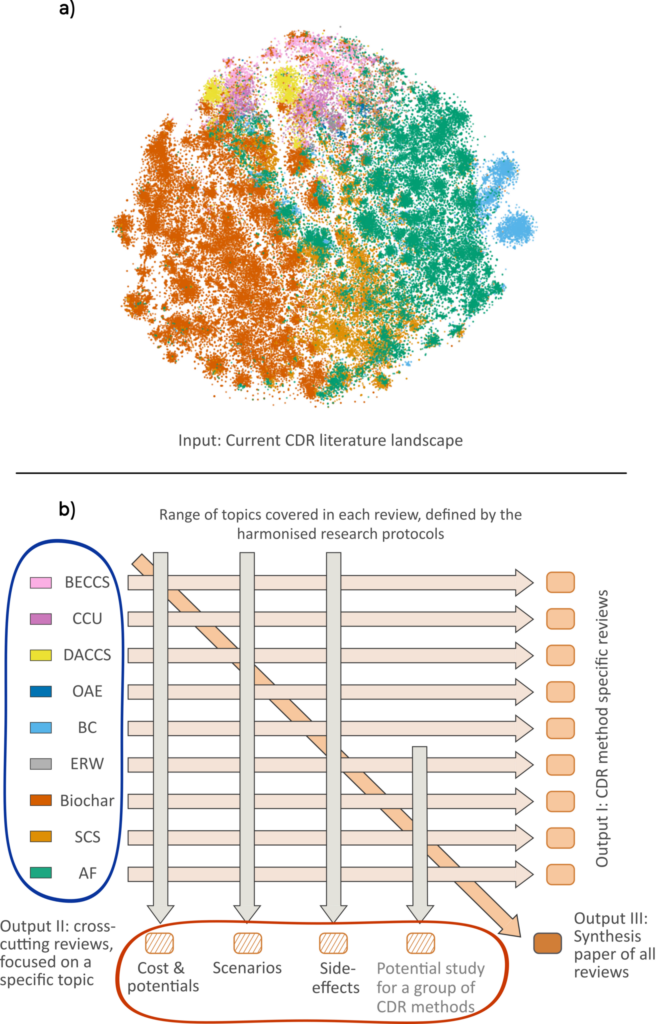
Figure: the concept of our ecosystem of systematic CDR reviews.
a) shows a systematic literature map, coloured by CDR method, developed following the methods described by Lück et al 2025. Arrows in b) show how each systematic review is constructed, including option-specific and cross-cutting reviews. CDR options included are bioenergy with CO2 capture and storage (BECCS), CO2 capture and utilisation in durable products (CCU), direct air CO2 capture and storage (DACCS), blue carbon (BC), ocean alkalinity enhancement (OAE), enhanced rock weathering (ERW), biochar, soil carbon sequestration (SCS) and afforestation / reforestation (AF)
What does each review cover?
All method reviews in the ecosystem address a common set of research questions and themes, agreed by the Scientific Steering Committee:
| Theme | What is covered |
| Literature landscape | Size, growth, geography and research gaps in the available literature |
| Technology status and readiness | Current deployment, technology readiness level, funding |
| CDR potential and scenarios | Technical, economic and sustainable potentials; role in climate pathways |
| Techno-economic assessment | Costs, inputs, outputs, removal efficiency, scalability |
| Side effects | Positive and negative environmental, social and economic side-effects |
| MRV | Monitoring, reporting and verification frameworks and challenges |
| Interactions | Known interactions with other CDR options |
In addition, review teams may include other optional topics, such as policy landscape, equity and justice dimensions, or social acceptance. These were left optional to accommodate variation in the size and breadth of literature bases for different options.
Where the literature base is very large (as is the case for soil carbon sequestration, for example), review teams can choose to conduct a systematic review of existing reviews and meta-studies.
Who is ESROC for?
ESROC is designed to serve a broad audience:
- Researchers will find a comprehensive, critically appraised synthesis of the CDR evidence base, including identified knowledge gaps and research priorities, as well as consistent parameters for use in modelling and scenario development.
- Policymakers and government advisors will find option-specific, comparable information on CDR potentials, costs, side-effects and governance that can inform CDR strategies and investment decisions.
- Funders and investors will find a clear picture of which CDR methods are more or less mature, where the key uncertainties lie, and where targeted investment could accelerate progress.
- Practitioners and developers will find granular technical and economic information relevant to the design and deployment of CDR projects.
- The wider public and civil society will find transparent, expert-assessed syntheses of what we know and don’t know about CDR options.
ESROC as a Process
ESROC was conceived to be an ongoing scientific process, rather than a one-time effort. The initiative draws on a systematic evidence map of the CDR literature, built using machine-learning methods and designed to be continuously updatable, as a shared foundation for all reviews. As new literature is published and new evidence emerges, the underlying map can be updated.
This approach reflects a commitment to living evidence: the idea that, in a fast-moving field like CDR, evidence synthesis must itself be dynamic. Rather than producing a comprehensive review that is out of date before it is published, ESROC is designed to evolve alongside the science.
The first review in the ecosystem focused on Direct Air Carbon Capture and Storage (DACCS) has been published. Further reviews are actively in progress. We also maintain an open process and welcome proposals for new reviews on CDR methods or cross-cutting themes not yet covered.

Open Call for Collaboration
ESROC is an open initiative. We actively invite researchers and experts to join our effort in the following ways:
–Join a review team–
If you have expertise in a specific CDR method or cross-cutting topic currently covered by ESROC and there is a gap in the existing team’s coverage, we welcome expressions of interest in joining. Review teams benefit from diverse disciplinary perspectives, including natural sciences, social sciences, engineering, economics and governance.
Are there CDR methods or cross-cutting themes not yet included in the ecosystem that you believe warrant a systematic review? We welcome proposals from the research community.
–Propose a new review–
–Contribute data or grey literature–
Review teams are particularly keen to incorporate evidence from deployment programmes, industry reports, and government strategies that may not appear in academic databases. If you are aware of relevant sources or datasets, we would like to hear from you.
If you are a policymaker, funder, practitioner or modeller with specific information needs — and you would like ESROC’s outputs to be relevant and useful to your work — we welcome the opportunity to understand your needs and, where possible, reflect them in our work