
Why the review matters
Although blue carbon ecosystems (BCEs), which include mangroves, seagrasses, salt marshes and macroalgae, have emerged as a promising natural climate solution, existing scientific research remains fragmented across different disciplines, regions and methodological approaches. The aim of this review is to comprehensively structure the current synthesis of findings in order to provide more robust and reliable estimates of carbon sequestration and removal potential of BCEs.
A key driver for this review is the need to bridge the persistent gap between scientific evidence and policy relevance. Important questions remain regarding the techno-economic feasibility of blue carbon pathways and how they can be effectively integrated into national carbon accounting frameworks, Nationally Determined Contributions (NDCs), and carbon markets. By systematically evaluating the state of knowledge, the authors aim to address these implementation challenges and highlight the need for multi-benefit strategies that balance climate mitigation with local livelihoods and biodiversity enhancement.
Short summary of the review
This systematic review evaluates the role of BCEs, such as mangroves, seagrass meadows, salt marshes and macroalgae, as carbon dioxide removal methods. It analyses their carbon sequestration potential, co-benefits, policy integration, costs and implementation challenges. Based on 2,622 peer-reviewed and grey literature articles from 1980 to 2025, the review provides refined estimates of carbon sequestration rates (270 MtC/year, which corresponds to 990.9 MtCO2/year across four main BCEs), updated coverage assessments (25–52 million ha for traditional BCEs, 606–722 million ha for macroalgae), current cost ranges (USD 5–1,700/tCO2) and an evaluation of co-benefits and potential interactions with other CDR methods. The review shows that challenges remain in translating these scientific advances into effective climate policy frameworks. Furthermore, a gap exists between science-based estimates and their consideration in policy. To translate the insights into practice, climate policy frameworks must incorporate blue carbon pathways by combining carbon sequestration with financial reward systems and additional incentives.
Brief description of review method
This systematic literature review (SLR) was conducted in accordance with PRISMA guidelines to ensure transparency and reproducibility throughout the research process. The authors searched three major databases, namely Web of Science, Scopus, and OpenAlex, using a harmonized Boolean search string. This string was developed according to PRESS (Peer Review of Electronic Search Strategies) recommendations and was validated against a set of studies identified by experts. The initial search returned 13,859 records. Three reviewers independently screened titles, abstracts and keywords, supported by a machine-learning tool trained on ClimateBERT (a language model fine-tuned for climate-related text) via the NACSOS platform. To maintain consistency, the reviewers conducted calibration rounds on random samples of 50 records at a time, refining their inclusion criteria as necessary. Eligible records had to include an abstract and be available in full text in English. Both peer-reviewed and grey literature were included. After removing duplicates and excluding records with missing data or quality issues, the team compiled a final dataset with 2,622 studies. These were merged with additional literature identified by experts and organized into topic-specific datasets, which were then made accessible via an internal keyword search engine allowing reviewers to cross-reference relevant studies directly. Due to the vast amount of literature available, the authors prioritized studies offering robust, well-documented findings and broader syntheses over narrower regional case studies.

Key results
Carbon sequestration and mitigation potential
The aggregated mean natural carbon sequestration of BCEs is estimated at approximately 990.9 MtCO2 per year (range: 389–1894 MtCO2/year).
Among these ecosystems, wild macroalgae and kelp contribute the highest natural sequestration, estimated at 173 MtC/year (634.9 MtCO2/year) and 56 MtC/year (205.5 MtCO2/year) respectively, while Mangroves exhibit the highest carbon density, with an average carbon stock of 350tC/hectare.
Protecting existing BCEs to avoid degradation could prevent emissions of 60 to 96 MtC/year (220 to 352 MtCO2/year) by 2050 and up to 218 MtC/year (800 MtCO2/year) by 2030. Active restoration of traditional blue carbon habitats such as mangroves, seagrasses, and salt marshes offers further removal potential, projected to be between 14 and 232 MtC/year (51-851 MtCO2/year) by the middle of the century. The theoretical potential for macroalgae-based methods is significantly higher, potentially reaching 1430 MtC/year (5248 MtCO2/year) if combined with technologies like deep ocean sinking or bioenergy with carbon capture and storage (BECCS).
Economic assessments reveal a large disparity in the cost-effectiveness of these natural solutions depending on the ecosystem type. Mangrove restoration is identified as the most cost-effective option, with approximately 85% of its global potential achievable at implementation costs below $20 per tCO2. In contrast, the costs for restoring seagrass meadows and salt marshes are notably higher, with point estimates of $300 and $200 per tCO2 respectively. Median total restoration costs per hectare reflect this gap, ranging from $2,985 for mangroves to $456,570 for seagrass. Observations from the voluntary carbon market show that consumers are willing to pay a premium for mangrove credits, with prices averaging $26 per tCO2 in 2023, which is nearly four times higher than the average market price.
BCEs experience annual loss rates of 0.28–2% for salt marshes, 0.13–0.62% for mangroves, 1–2% for seagrasses, and 1.8% for macroalgae. These losses are exacerbated further by climate change, coastal development and pollution, all of which threaten their carbon storage capacity.
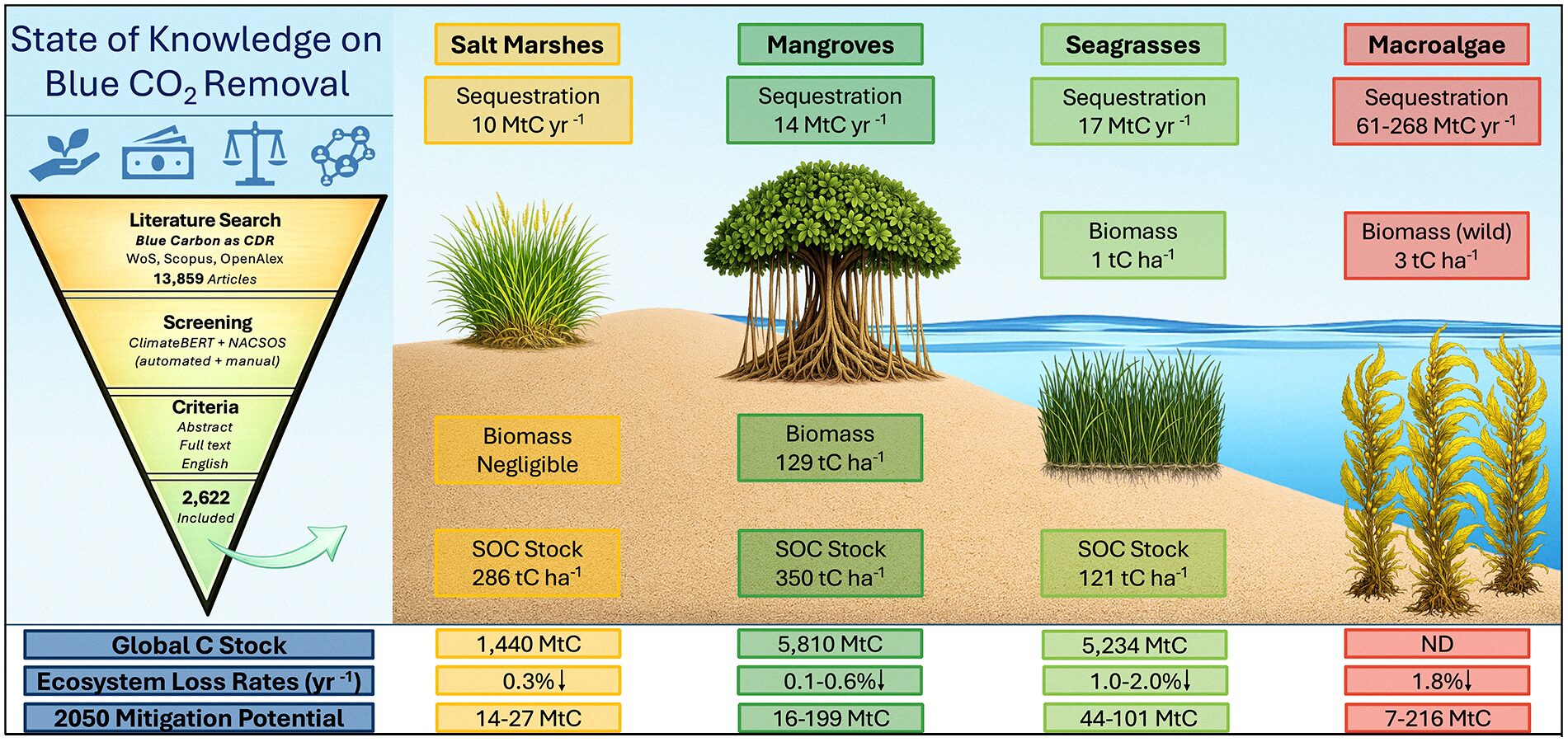
Figure: Estimated carbon stocks and sequestration rates by ecosystem and carbon pool. Per-area carbon stock and sequestration rate values are given in tons of carbon per hectare and tons of carbon per hectare per year, respectively. Global carbon stock and sequestration rate values are given in megatons of carbon and megatons of carbon per year, respectively
Spatial distribution
Mangroves cover 15 million ha (8–16 mio ha), seagrasses 21 million ha (14–27mio ha), and salt marshes 5 million ha (3–9mio ha). Macroalgae span 606–722 million ha, including all seaweeds.
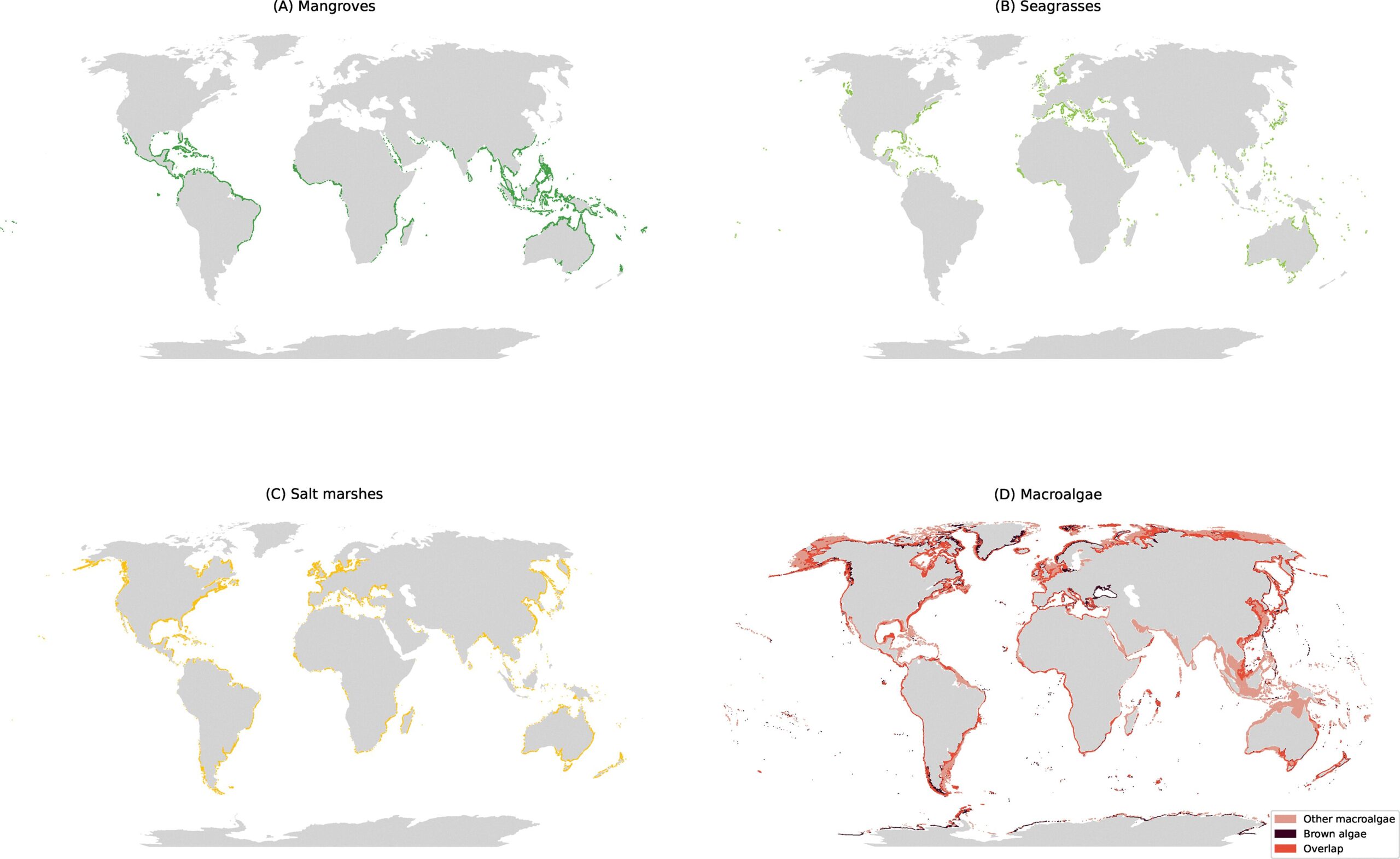
Figure: Global distribution of blue carbon ecosystems. (A) mangroves, (B) seagrass meadows, (C) salt marshes, and (D) macroalgae
Co-benefits and negative side effects
The results also emphasize that these ecosystems provide vital co-benefits, such as coastal protection valued at an annual global median of $447 billion USD and a strong positive correlation with local fishery catches. However, negative side effects are a critical consideration, particularly the production of methane (CH₄) and nitrous oxide (N₂O) during the decomposition of organic matter. Methane emissions from macroalgae and mixed vegetation can offset as much as 35% of the carbon dioxide absorbed by these habitats annually. Additionally, the large-scale expansion of macroalgae farms could lead to nutrient competition, potentially reducing the productivity of other primary producers like phytoplankton and altering marine food webs.
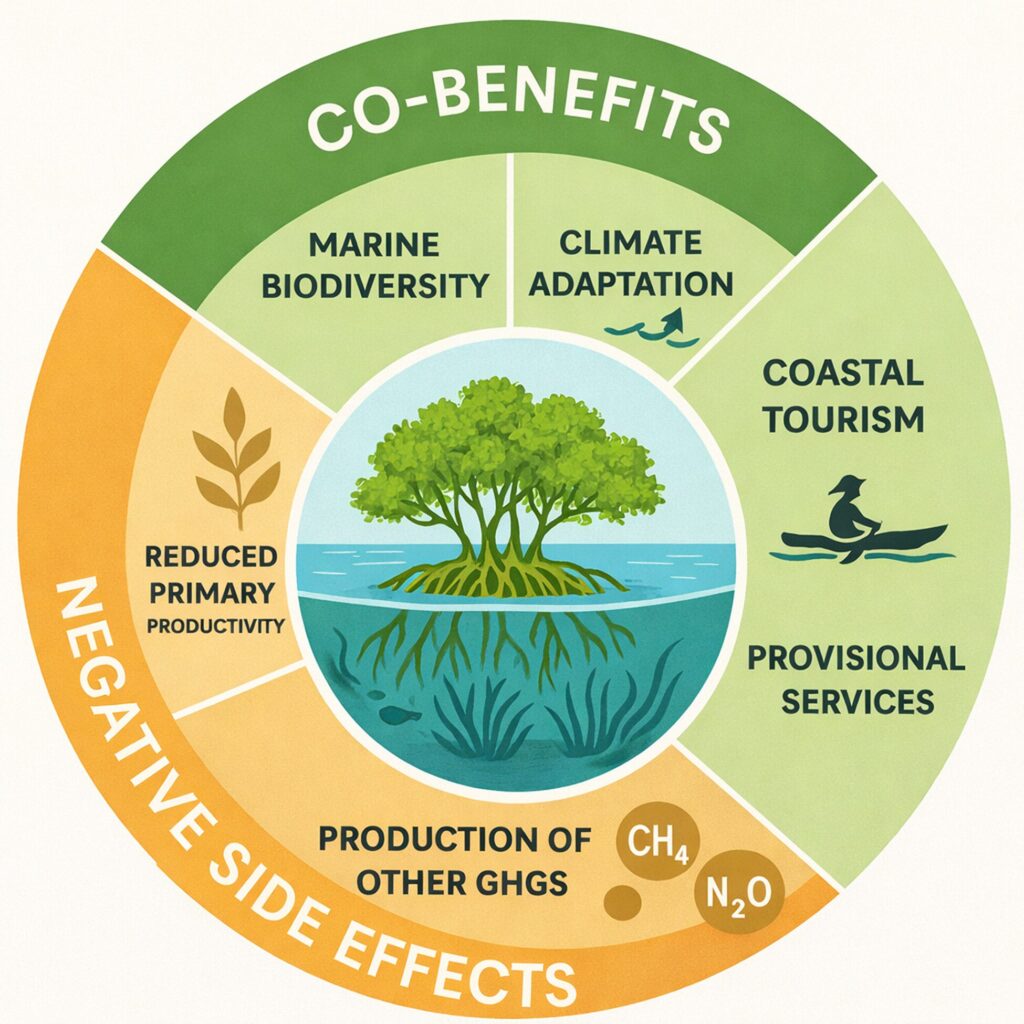
Figure: Visualization of the positive co-benefits and negative side effects for blue carbon ecosystem restoration and protection. The co-benefits outweigh the side effects.
Climate policy
BCEs are increasingly recognised in climate policy, with 74 countries mentioning coastal wetlands in their Nationally Determined Contributions (NDCs) under the Paris Agreement. However, only a few countries, including Australia, the US and Japan, currently include BCEs in their national greenhouse gas inventories. Australia includes carbon from mangroves and salt marshes under the wetland category, while Japan reports removals from mangroves, seagrasses, and macroalgae (approximately 0.35 MtCO₂eq/year). There has been limited participation of BCEs in the voluntary carbon market (VCM), with only 11 MtCO₂ traded between 2020 and 2023, which was dominated by mangrove projects. Although legal frameworks such as Article 6 of the Paris Agreement enable carbon credit trading for BCEs, challenges remain in standardising monitoring, reporting and verification (MRV), and in ensuring permanence and additionality.
Future Directions
A key priority is the comprehensive integration of BCEs into national climate strategies, particularly through their inclusion in NDCs and national greenhouse gas inventories. While 74 nations already acknowledge coastal wetlands in their NDCs, specific quantitative targets for the contribution of blue carbon are often missing and must be more clearly defined in future updates. This is particularly the case in countries with degraded or threatened coastal and marine ecosystems.
Another key research priority is developing standardized and robust monitoring, reporting and verification (MRV) frameworks (click here fore more information on MRV) . These frameworks are essential for accurately tracking carbon removal and ensuring the reliability of the data required for financial incentive programmes. Furthermore, future implementation must move towards multi-benefit strategies that prioritize ecological co-benefits and local livelihoods alongside carbon sequestration. Aligning these objectives with social justice is vital, particularly in the Global South, to ensure that local communities actively participate in project design and that clear benefit-sharing rules are established to prevent adverse outcomes such as land grabbing or dispossession.
Furthermore, it is emphasized that BCEs should be treated as part of a broader CDR portfolio, with a focus on exploring synergistic interactions with other marine methods, such as ocean alkalinity enhancement or artificial upwelling, in order to optimize carbon removal while minimizing negative ecological side effects. Combining financial incentives with multiple benefits that respect or enhance local livelihoods could have a positive effect on public perception at local and broader societal levels.
Find the full review here: Christian Rischer, Ignacio Saldivia Gonzatti, Daniel A. Friess, Patricia Grasse, David Keller, Johannes R. Krause, Sarah Lück, Carisa MacPherson, Jennifer McHenry, Christine Merk, Tiffany Troxler, Rudi Voss, Wilfried Rickels; An ecosystem of carbon dioxide removal reviews – part 2: CO2 removal via blue carbon ecosystems. Energy Environ. Sci. 2026; 19 (12): 3719–3755. https://doi.org/10.1039/d5ee04922a