
A systematic assessment of
Carbon Dioxide Removal technologies
Ecosystem of Systematic Reviews on Carbon Dioxide Removal
scroll down to learn more about CDR

What is Carbon Dioxide Removal (CDR)?
To be defined as Carbon Dioxide Removal, a method must
o capture carbon dioxide (CO2) from the –atmosphere–
o –store– the captured carbon –durably–
o be a result of deliberate –human intervention–


CDR can fulfil three major functions
1. In the short term, it can help to reduce net emissions
2. In the medium term, it can counterbalance residual emissions in order to achieve net-zero CO₂ or net-zero GHG emissions
3. In the longer term, CDR can help to achieve net negative emissions if removals exceed emissions
There are various CDR methods that differ in terms of
.CO₂ storage duration , .costs and .potential.
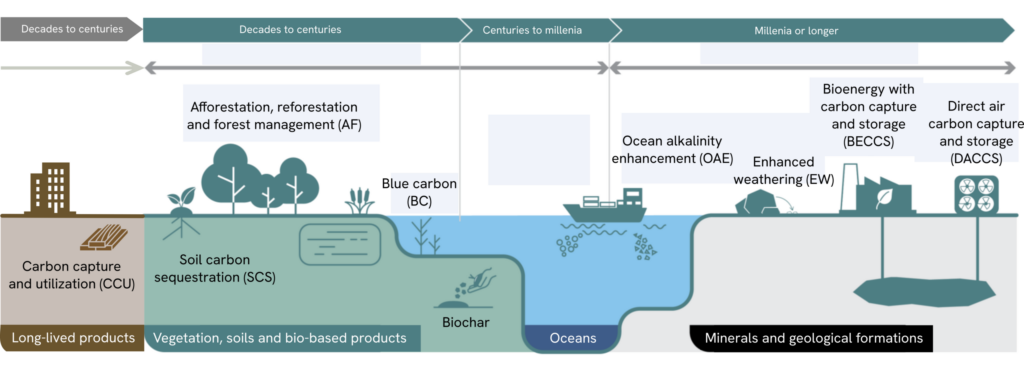
Carbon dioxide removal technologies can be distinguished by their capture process and implementation options, the earth system in which they operate, and the storage medium. Five out of the seven technology clusters considered (AF, SCS, BECCS, BC) use photosynthesis for capturing the CO2. Only EW (incl. ocean alkalinization) and DACCS bind the CO2 through chemical processes. A central distinction is whether the technology is land or ocean-based, as the latter can involve transboundary pollution issues and will require higher levels of international coordination—particularly if larger scale applications are intended. Finally, the storage medium is of great interest as there can be a significant variation in the reliability, permanence and overall quantity of available CO2 storage. In principle, the literature highlights that land management approaches such as AF and SCS provide more vulnerable (and less verifiable) storage options, where stored CO2 can be released again within short time frames. In contrast, geological reservoirs used by BECCS and DACCS are thought to provide a larger and less vulnerable storage option.
Why do we need CDR and evidence synthesis?
Reaching international goals
With the Paris Agreement’s ambition of limiting climate change to well below 2°C and possibly even below 1.5°C, carbon dioxide removal technologies (CDRs) have moved into the limelight of discussions in climate science and policy. Carbon dioxide removal refers to the intentional removal of CO2 from the atmosphere. A wide range of technologies can be used in this effort, from planting trees and enhancing soil carbon, to combusting biomass, capturing the emissions and storing it in reservoirs.
Despite several assessments of CDRs, the current knowledge on CDRs is still diffuse and incomplete, but also growing fast. This website is dedicated to the assessment of carbon dioxide removal (CDR) technologies. CDR has become an integral part of solution portfolios that limit global warming well below 2°C in accordance with the Paris Agreement. Yet, our knowledge of these technologies is scattered around thousands of scientific publications. This website reports on efforts to synthesize the available knowledge on different CDR technologies.
Why do we need Evidence Synthesis
This website is dedicated to systematic approaches for evidence synthesis acknowledging that learning requires a formal research on research results. This is paramount in order to spend limited funding resources efficiently and provide policymakers with robust scientific evidence. Hence, results presented on this website are from projects that follow transparent procedure for the identification, selection and assessment of CDR technologies.
What are Systematic Reviews
“Systematic review” refers to a whole suite of formal methods to aggregate evidence into discrete bodies of knowledge by reconciling evidence and understanding sources of variation in a rigorous way. Guided by the principles of reproducibility and transparency include formal quantitative methods for aggregating statistical and experimental research (such as meta-analysis), methods to review qualitative theory and evidence (such as meta-ethnographies), as well as methods to compile mixed quantitative and qualitative evidence (such as realist reviews).
Yet, all approaches share the feature that they follow a clear methodological protocol that involves the following steps:
1) clearly defining the research question;
2) systematically searching defined literature databases for a defined time period;
3) justifying and making transparent sources and selection of the literature;
4) systematically assessing the quality of the selected evidence;
5) justifying and making transparent methods used to synthesize the evidence based; and
6) appraising confidence in the results
