
Why the review matters
Direct air capture with carbon storage (DACCS) is one of the most widely discussed CDR technologies. However, previous reviews on this topic have tended to cover a wide range of CDR methods without offering sufficient depth to inform policy and investment decisions on individual methods. Thus, this review summarizes the rapidly growing body of literature on DACCS (over 800 peer-reviewed studies) and provides a comprehensive, rigorous and policy-relevant resource covering technology, economics, environmental performance, governance, public perception and future deployment scenarios.
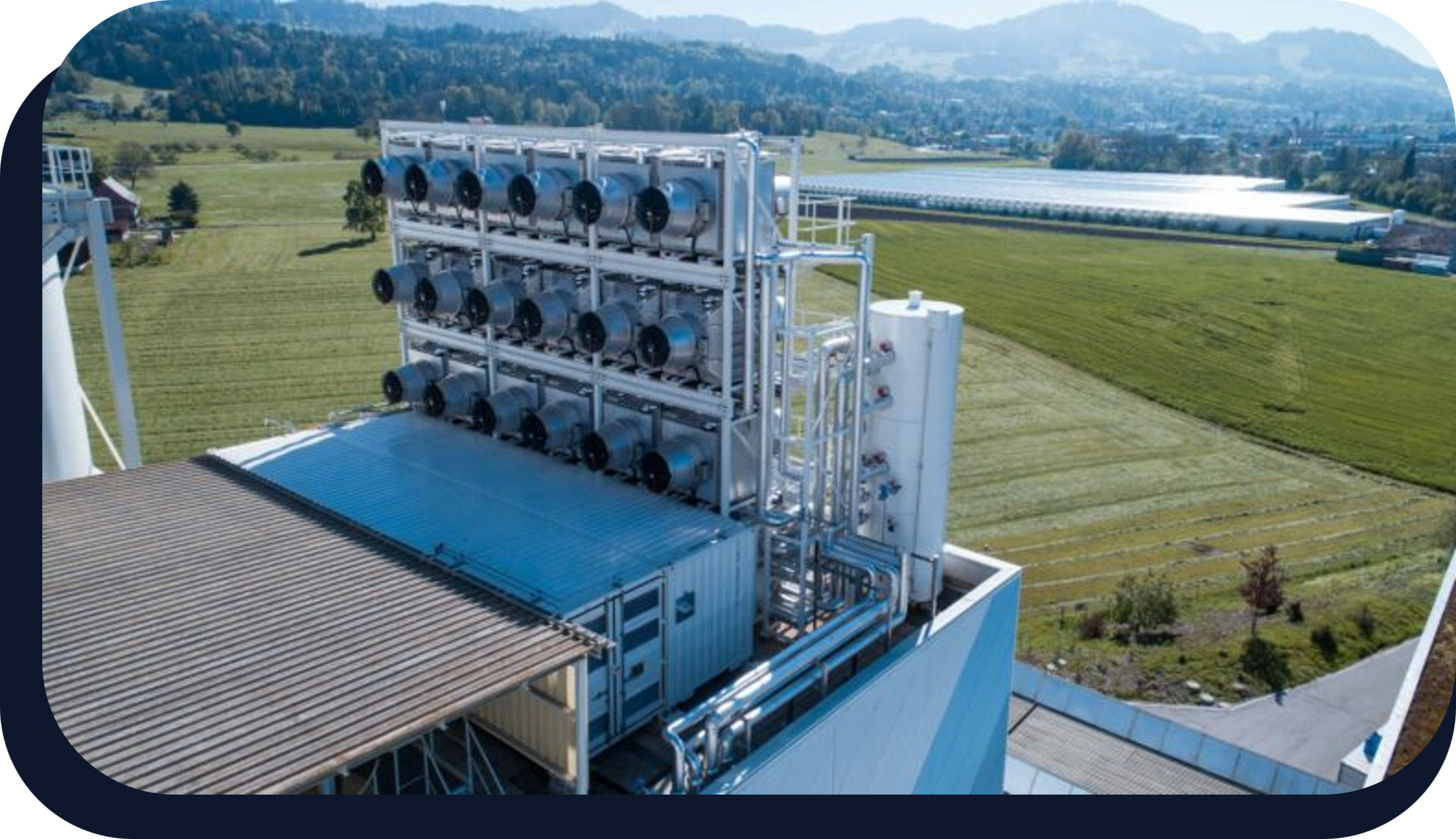
Short summary of the review
The authors conducted a systematic review of the scientific literature on DACCS, which was structured around eight technology categories:
- Solid adsorbents
- Liquid absorbents with calcium looping regeneration
- Liquid absorbents with electrochemical regeneration
- Solid adsorbents with electrochemical regeneration
- Amine and amino acid-based liquid absorbents with thermal regeneration
- Mineral looping
- Membrane-based DAC, and
- Cryogenic DAC
In the review, the technical maturity, energy consumption, costs, life-cycle environmental impacts, socio-political and equity dimensions, public perceptions and monitoring, reporting and verification (MRV) frameworks of DACCS were assessed. Additionally, its projected role in climate mitigation scenarios was considered.
Brief description of review method
The review followed a four-step systematic methodology:
(i) a protocol defined screening criteria, inclusion/exclusion topics, and data coding;
(ii) automated literature search and classification, supported by machine learning (as outlined in Lück et al., 2025)
(iii) data extraction and harmonization by specialized reviewers; and
(iv) synthesis and analysis. The review included over 800 peer-reviewed papers published by August 31, 2024, and selectively incorporated peer-reviewed grey literature for additional insights.
Key results
Research landscape and technology development
The research landscape is growing rapidly and diversifying, with an increase in technology and process development, and more technology and systems analysis studies. Social sciences and humanities studies are emerging, though more is needed to inform implementation and policy making, especially in regions outside Europe and North America.
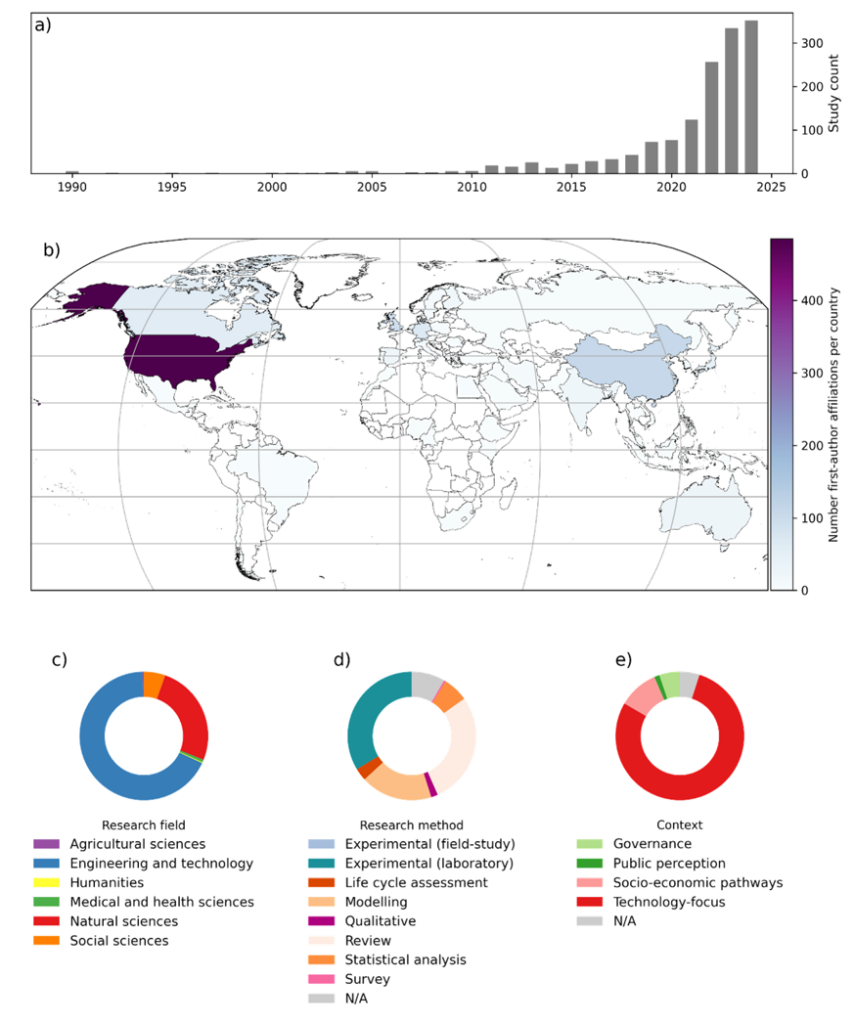
Figure DACCS research landscape, a)number of studies per year;b) number of studies per country (based on first-author affiliation). c) share of research fields the studies were published in (based on OpenAlex field classifications); d) share of scientific methods used in the studies; f) share of the main context in each study. For c–e) we used the most prominent category per study (Source: van der Spek et al., 2025)
DAC technology is becoming more diverse, with new approaches being published regularly. These suggest improvements in performance, especially in terms of energy use, as they address high energy consumption in CO2 separation from air. This review identified eight technology categories. First and second-generation technologies have advanced to higher TRLs, with solid adsorbent and mineral looping technology reaching TRL 9, and liquid solvent with mineral looping expected to reach TRL 9 in 2025. Several second-generation technologies have progressed to the pilot plant stage (TRL 6 or 7).
Technology performance
The central finding is that, although the field is diversifying and several technologies have reached the pilot or early commercial stage, none has yet demonstrated a viable route to achieving the low costs often cited by the industry, such as $100/tCO2 Realistic long-term costs are estimated to be between $100 and $600/tCO2 removed. Furthermore, energy consumption has not meaningfully declined over two decades of research. Life-cycle assessments show that DACCS is generally net carbon-negative, though its climate benefit and other environmental impacts depend strongly on the carbon intensity of the electricity used.
Upscaling & IAMs
Integrated assessment models (IAMs) suggest that deployment in the near term will be limited, with almost 90% of AR6 scenarios showing DACCS deployment of less than 1 GtCO2/year until 2050, with a median of just 23 MtCO2/year. Significant DAC uptake only appears in the second half of the century, when carbon prices exceed 2,000 $/tCO2. However, new REMIND results suggest that scaling could occur at around 300 $/tCO2.
Policy, MRV, and public perception
For DACCS to be a serious mitigation option, policymakers need to step up and implement stronger, long-term DACCS/CDR policies to create markets and financial incentives. This must be accompanied by legislation for CO2 transport and storage, the supply of low-carbon energy, and integration with the broader energy transition. To maintain public support, policies must foster equity and social justice; unjust or inequitable implementation could erode current support, especially given concerns about Western corporate and investor dominance. Currently, few MRV protocols certify DACCS carbon removal performance, which hinders market development. Robust governance frameworks for MRV are needed to build trust.
Future directions
To advance DACCS, research must prioritize understanding material degradation, pollutant emissions, and local environmental impacts, which are currently understudied. Scaling all technology categories to pilot plants is essential to validate lab-based performance claims and identify bottlenecks. Long-term incentives, similar to those that supported the growth of renewable energy, are necessary to drive early deployment, reduce costs through learning-by-doing, and achieve parity with carbon market prices. Expanding CO2 transport and storage infrastructure, as well as integrating DACCS with broader energy transition strategies, will also be critical. Finally, developing robust MRV frameworks and ensuring equitable implementation will help secure public support and build confidence in DACCS as a reliable carbon removal strategy. Niche applications, such as decentralized CO2 production in remote locations, may also offer early opportunities for deployment.
Read the full review here: van der Spek, M., Bardow, A., Baum, C. M., Bolongaro, V., Dufour-Décieux, V., Esch, C., Fritz, L., Garcia, S., Hamann, C., Hondeborg, D., Kiani, A., Lück, S., Patel, S. K., Peh, S. B., Pisciotta, M., Psarras, P., Repke, T., Sáenz-Cavazos, P. A., Schulte, I., Shu, D., Shu, Q., Sovacool, B., Strefler, J., Castaño, S. V., Wang, J.-Y., Wessling, M., Wilcox, J., Young, J., Minx, J. C. (2025): An ecosystem of carbon dioxide removal reviews – part 1: direct air CO₂ capture and storage. - Energy & Environmental Science, 18, 22, 9713-9785. https://doi.org/10.1039/D5EE01732G