
Why it matters
Understanding the side effects of CDR is essential for evaluating the sustainability and scalability of different CDR options
Assessments based solely on carbon removal potential may overlook important environmental, social, economic, and governance implications. A systematic overview of side effects helps identify trade-offs, co-benefits, and risks that should be considered when designing climate mitigation strategies.
Short summary
Carbon dioxide removal (CDR) can have a wide range of side effects beyond its primary goal of removing CO₂ from the atmosphere. These side effects include both co-benefits and challenges that affect environmental systems, human well-being, economic development, and the feasibility of implementation. This study develops a taxonomy to systematically organize and compare the diverse side effects associated with six land-based CDR approaches.
Brief description of methods
A systematic review of the scientific literature was used to identify and categorize reported side effects of carbon dioxide removal technologies and practices. Evidence from relevant studies was synthesized into a structured taxonomy covering different types of impacts.
Key results
Nearly 400 side effects of carbon dioxide removal were identified and grouped into three broad categories: environmental and human health effects, economic prosperity and societal well-being effects, and implementation challenges. The evidence shows that side effects vary considerably between CDR approaches and that potential challenges and negative impacts are discussed more frequently than co-benefits. Research is concentrated on side effects related to afforestation/reforestation, biochar, and bioenergy with carbon capture and storage (BECCS), while potential side effects of direct air carbon capture and storage (DACCS) and enhanced weathering are less extensively studied. Significant geographical gaps also exist, with limited evidence available for Africa, South America, and Oceania.
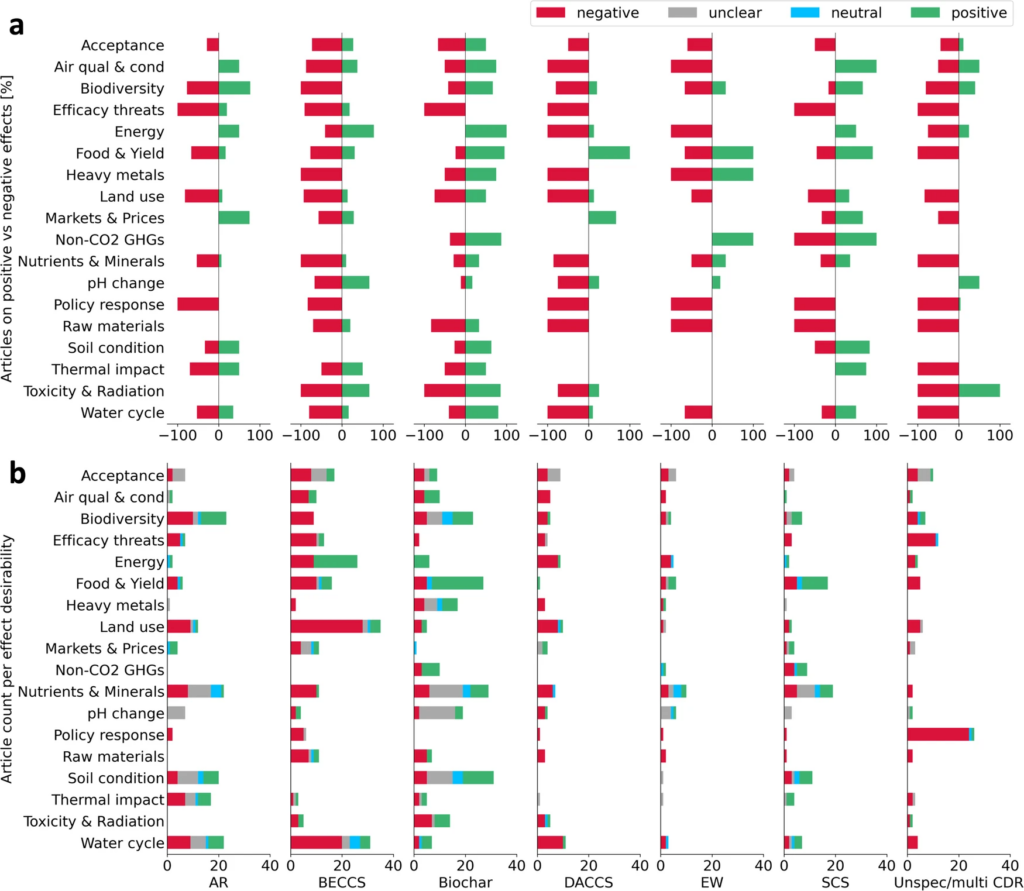
Where available, information on the desirability of effects was directly taken from the respective articles. Otherwise, effect desirability was assigned manually as long as desirability was unambiguous and not strongly context-dependent. More information on the approach is provided in the Methods section of the study. a shows the share of articles mentioning positive versus negative effects per effect category and CDR option. b shows the number of articles per mentioned effect desirability. Effect desirability is not aggregated within or across articles. Thus, double counting of articles is possible if articles mention multiple different effect desirabilities per effect category and CDR option (Prütz et al., 2024)
Future directions
Future research should strengthen the evidence base by addressing geographical gaps, particularly in regions expected to play an important role in future CDR deployment. Additional work is needed to assess understudied technologies, quantify the magnitude of reported effects, and better understand interactions among environmental, social, and economic outcomes. Expanding this knowledge will improve the design of carbon removal portfolios that maximize benefits while minimizing risks and trade-offs.
Read the full article here: Prütz, R., Fuss, S., Lück, S. et al. A taxonomy to map evidence on the co-benefits, challenges, and limits of carbon dioxide removal. Commun Earth Environ 5, 197 (2024). https://doi.org/10.1038/s43247-024-01365-z